3.0 Self-Leveling Concrete & Masonry Sealant
DAP · hybrid polymer
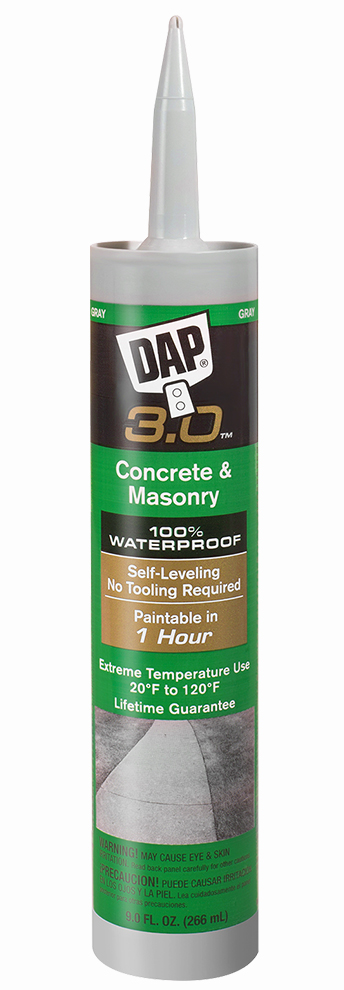
Full cure (70°F / 50% RH)
24h
Min application temp
20°F
Max application temp
120°F
Open time
30 min
Dry to touch
120 min
Estimate Cure Time
Common use-case guides
When this estimate may be unsafe
- - The joint, bead, pour, or repair is thicker than the product data sheet assumes.
- - The substrate is colder than the surrounding air, wet, oily, dusty, painted, or otherwise poorly prepared.
- - The repair will carry weight, resist water pressure, or be safety-critical before full cure.
Compare with similar products
Quick answers
How long does 3.0 Self-Leveling Concrete & Masonry Sealant take to cure?
3.0 Self-Leveling Concrete & Masonry Sealant fully cures in 24 hours at standard laboratory conditions, usually 70°F / 21°C and 50% relative humidity. At colder temperatures or difficult humidity, cure time can increase significantly.
What is the minimum temperature to use 3.0 Self-Leveling Concrete & Masonry Sealant?
The minimum application temperature for 3.0 Self-Leveling Concrete & Masonry Sealant is 20°F (-7°C). Applying below this threshold can prevent proper curing and cause the bond or seal to fail.
How long does 3.0 Self-Leveling Concrete & Masonry Sealant take to cure in cold weather?
Cold temperatures significantly extend cure time. As a rule of thumb, every 18°F (10°C) below 70°F can roughly double cure time. Enter your actual temperature in the calculator for a product-specific estimate.
Does humidity affect 3.0 Self-Leveling Concrete & Masonry Sealant cure time?
Yes. 3.0 Self-Leveling Concrete & Masonry Sealant needs atmospheric moisture to trigger its cure reaction. Below 30% RH curing will stall. Above 80% RH premature surface skinning can prevent interior cure. Optimal range is 40-70% RH.
What is the open time for 3.0 Self-Leveling Concrete & Masonry Sealant?
3.0 Self-Leveling Concrete & Masonry Sealant has a working open time of 30 minutes at standard conditions. At higher temperatures open time may shorten; at lower temperatures cure may slow after assembly.